Showing posts with label schools maths shanghai. Show all posts

Wednesday, 2 December 2015

The Maths Teachers of Shanghai have the Perfect Formula for Learning By Nick Gibb

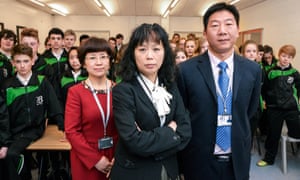
Shot from the BBC's TV programme Are Our Kids Tough Enough? Chinese School showing three teachers (left to right Li Aiyun, Jun Yang-Williams, Hailian Zou) standing in front of a classroom of pupils

Earlier this month, I welcomed 68 secondary mathematics teachers from Shanghai to England. They had just touched down to spend three weeks teaching in our secondary schools. Now in its second year, the Shanghai-England teacher exchange is one of the most valuable education initiatives undertaken by our government over the past few years.
Why are we so keen to learn about Shanghai mathematics teaching? Because Shanghai, a city of 24 million people, tops the Organisation for Economic Co-operation and Development’s (OECD) international league table for maths achievement, and by a considerable margin. (China does not participate as a country but is represented by Shanghai and Hong Kong). At the age of 15, Shanghai pupils are studying work equivalent to the second year of A-level, while our pupils are still studying for their GCSE. What’s more, the children of the poorest 30% of Shanghai’s population are outstripping at mathematics the children of our wealthiest 10% in England. Clearly, Shanghai teachers are doing something right.
There are many who try to attribute Shanghai’s achievement to supposed socio-cultural explanations. These critics point towards “tiger mothers”, China’s growing economy, or the deferential nature of Chinese society to explain away their success. These crude national stereotypes are not the issue; it is simply narrow-mindedness to insist that there is nothing we can learn from finding out what happens inside Shanghai’s classrooms. Once inside, we can see that Shanghai teaching is very different from what we too often see in England.
This could be seen from the BBC documentary Chinese School, aired over the summer. I recently met Jun Yang-Williams, the science teacher from the programme, who (though the producers neglected to mention this fact) has taught in English schools for the past 10 years.
Having started her career teaching in China’s Xi’an province, Yang-Williams is in a privileged position to compare schools in both countries. In a letter she wrote to me following our meeting, she explained: “It seems to me that British schools have almost dismissed the ‘teacher-led’ teaching style … Although the ‘teacher-led’ pedagogy is seen as passive, it does not necessarily jeopardise learning outcomes. Students are in fact more proactive and more responsible for their learning.”
Last year, Professor David Reynolds of Southampton University, and postgraduate research student Zhenzhen Miao, tested 562 nine- and 10-year-olds from Southampton and from Nanjing in China, using maths tests from the international research projectTimss. The average Chinese score was 83%, and the average English score was 56%.
More interesting than this was when the researchers videoed lessons in both countries, to find out what teaching methods were being used. The answer was clear: in Chinese classrooms, whole-class teaching made up 72% of lesson time, compared with 24% in England.
In addition, Shanghai mathematics teaching is based upon high-quality teacher resources. All schools follow the same textbook, which is published by the Shanghai education commission and refined and revised on an annual basis. Compare this with English schools, where, according to the Timss international survey, only 10% of mathematics teachers used textbooks as a basis for their teaching.
An enormous amount of thought and care has gone into the construction of the Shanghai mathematics curriculum, and it is anything but a straitjacket for teachers. These high-quality resources simply provide the foundation upon which creative and imaginative teaching can be built. No teacher is delivering someone else’s script.
Teaching in England is still hobbled by the misplaced idea that teacher instruction is irredeemably boring. But anyone who has visited Shanghai will know this is not the case. Primary and secondary teachers involved in the exchange have returned to England beaming at how interactive whole-class teaching in Shanghai can be. Though teaching large classes, Shanghai teachers are constantly asking and answering questions, inviting pupils to demonstrate solutions on the board, and quizzing pupils about their thinking.
And as for the myth that all Shanghai pupils are miserable, we know this is untrue because the pupils have said so themselves. The 2012 Pisa survey asked pupils whether they agreed with the following statement: “I feel happy at school.” In Shanghai, 85% of pupils agreed with the statement, which was above the OECD average, and above – I am sorry to say – the United Kingdom.
Shanghai maths teaching works because it is meticulous. No pupil understanding is left to chance or accident: every step of a lesson is deliberate, purposeful and precise. If the Shanghai teacher exchange can show enough English teachers the merits of such practice, it will have been a resounding success.


Sunday, 29 November 2015

Shanghai Teaching Method 'Could Improve UK Results Within Four Years' By Sally Weale

Lianjie Lu, a maths teacher from Shanghai, delivers a maths lesson to students at Fox primary school in Notting Hill, London.
The government’s controversial experiment with Shanghai mathematics teaching in English schools could pay dividends with improved test results within four years, according to one leading expert.
David Reynolds, professor of education at Southampton University, said it was “not beyond the realms of possibility” that UK pupils could post better scores in the next round of Pisa international tests in 2018 (and published the following year) thanks to the Shanghai-style teaching.
The Department for Education (DfE) is in the second year of a Shanghai-England teacher exchange which aims to raise English pupils’ maths skills. Shanghai currently tops the international maths league table published by the OECD, while UK pupils lag behind in 26th position .
The Shanghai approach is to shape each maths lesson so it concentrates on a single mathematical concept, which is covered methodically and in great depth. The class does not move on until every child has mastered the lesson.
This month nearly 70 Shanghai maths teachers are working in English secondary schools, demonstrating their teacher-led “mastery method” to English counterparts. It involves whole-class, interactive teaching to an all-ability group.
“I’m an enthusiast,” said Reynolds, who is a member of the Sheffield Hallam university committee set up to evaluate the UK-Shanghai experiment. “Everything one hears about it is impressive and suggests it’s useful.”
Fifteen-year-olds in OECD countries have just sat this year’s Pisa test, the results of which will be published next year, which will be too soon to show any impact, the professor said. “But the Pisa after [in 2018 - the tests are triennial], we might be talking about making a substantial improvement.” Others believe it will take longer.
At St Mark’s Catholic school in Hounslow, west London, directly beneath the thunder of the Heathrow flight path, Miss Li Chen from Shanghai is trying to impart the commutative law of multiplication to a class of year 7 pupils.
English pupils would not ordinarily be aware they are learning the law of commutativity. They would learn the maths, without being taught the law behind it - a sort of “dumbing down” we favour here, one teacher observing the lesson commented.
Miss Chen is bright and energetic; she addresses the whole class in a teacher-led approach, which is less popular in the UK, regularly engaging with pupils, asking them to supply the answers and explain their work to the class.
“I think they are smart,” said Miss Chen, after class. A key difference is that her students in Shanghai get homework every day, with a test every week. (In England pupils can expect maths homework once or twice a week.) “We push them to learn more and try more. In England that’s not the way.”
Miss Yingzhen Guo, who is also working at St Mark’s, added: “They understand and answer the questions quickly. Next day I ask them and maybe they forget. In China they do a lot of work at home.” As well as homework, many children in Shanghai will have private tutoring and weekend school.
The St Mark’s pupils seem to have enjoyed their Shanghai lessons and have found them relatively easy. “First I thought it might be confusing, but then I realised it’s a bit easy,” said Jairus Gonsalves, aged 11. “I’ve been learning some of this before. I love maths.”
“It’s really interesting to have a teacher from another country,” said Antonia Woznica, 11, “but it’s not that different. This lesson was pretty simple. I didn’t have to work particularly fast.”
“I feel they are just the same as the ordinary lessons,” said 12-year-old Henry Beesley. “I assume it’s to boost our learning in maths but I see no difference. I would rather be in an English lesson.”
Schools minister Nick Gibb, who is leading the Shanghai project, writing in the Guardian, described it as “one of the most valuable education initiatives undertaken by our government over the past few years.
“Shanghai mathematics teaching works because it is meticulous. Every step of a lesson is deliberate, purposeful and precise. If the Shanghai teacher exchange can show enough English teachers the merits of such practice, it will have been a resounding success.”
Not everyone is quite so enthusiastic.John Jerrim, of the UCL Institute of Education, who has carried outresearch into the effectiveness of the east Asian maths mastery approach, welcomed the project, but urged caution.
“To their credit, the DfE are going about this in a reasonable way. They are doing a proper evaluation through an independent group.” He added, however: “The minister may want to wait for the results of that evaluation to see what they say before jumping to any strong conclusions.
“Teaching methods may differ but there’s a whole lot of other explanations [for Shanghai’s success], ranging from culture, to private tutoring and parental investment. To tease out the role of those different factors is incredibly difficult.”
Jerrim’s research focussed on the Singaporean mastery method - similar to that of Shanghai - which has been adopted in a number of primary and secondary schools in the Ark academy chain.
“What we know from that is that it leads to a small positive gain in maths test scores, but the emphasis should be on small. It’s not a silver bullet. It’s not game changing.
“Other countries could possibly learn from what the DfE here is doing but I would be more cautious about second guessing conclusions. We should wait for the evaluation results to see what it’s showing.”